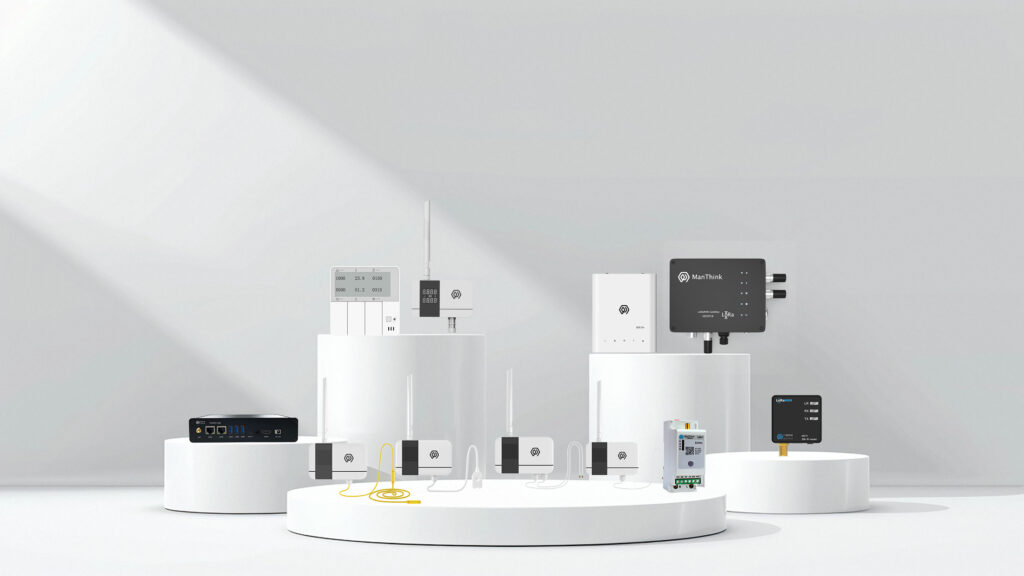
LoRaWAN Gateway Supplier

Top Features to Look for in a LoRaWAN Gateway Supplier

Choosing a reliable LoRaWAN Gateway Supplier is a critical decision that dictates the performance, scalability, and long-term viability of your Internet of Things (IoT) network. A gateway is the central bridge connecting your end-devices (sensors) to the network server, making its quality paramount. When evaluating potential vendors, moving beyond basic price comparison is essential. You must scrutinize […]

Top Features to Look for in a LoRaWAN Gateway Supplier Read More »

LoRaWAN base station

How LoRaWAN Base Stations Are Revolutionizing IoT Connectivity?

This webpage explores how LoRaWAN connectivity is reshaping the IoT landscape, why the LoRaWAN base station is a transformative element, and how Manthink Technology is advancing this evolution with next-generation engineering. In today’s fast-evolving digital landscape, the Internet of Things (IoT) is no longer a futuristic concept—it is the backbone of modern smart cities, industrial automation, and

How LoRaWAN Base Stations Are Revolutionizing IoT Connectivity? Read More »

Deep Technical Analysis of LoRaWAN Gateway Channels, Frequencies and Demodulators Based on the SX1302 Architecture

In a LoRaWAN architecture, the gateway forms the core link between end devices and the Network Server (NS). Its capability to receive, decode, and forward uplink frames is primarily determined by its RF front-end and the baseband processing architecture. Modern LoRaWAN gateways commonly adopt the Semtech SX1302 chipset, which significantly enhances concurrent reception and multi-channel

Deep Technical Analysis of LoRaWAN Gateway Channels, Frequencies and Demodulators Based on the SX1302 Architecture Read More »

How to Achieve Reliable FUOTA on LoRaWAN Devices Technical Analysis and Engineering Best Practices

Over the air firmware update is a core requirement for large scale IoT deployments especially when LoRaWAN devices are distributed in remote and inaccessible environments Since LoRaWAN provides low data rate strict payload limitation and downlink constraints FUOTA becomes a technical challenge This article explains the engineering difficulties behind LoRaWAN FUOTA and presents Manthink’s mature

How to Achieve Reliable FUOTA on LoRaWAN Devices Technical Analysis and Engineering Best Practices Read More »

LoRaWAN FUOTA: Mechanisms, Challenges, and Engineering-Grade Solutions

In large-scale IoT deployments, many devices operate in locations where physical maintenance is nearly impossible. Firmware Update Over the Air (FUOTA) becomes indispensable for long-term device stability, especially for LoRaWAN devices operating on low bandwidth and limited payload size. This article explains the technical principles behind FUOTA, analyzes LoRaWAN-specific challenges, and introduces Manthink’s engineering-grade upgrade

LoRaWAN FUOTA: Mechanisms, Challenges, and Engineering-Grade Solutions Read More »

In-Depth Comparison of LoRaWAN Network Servers: ThinkLink, TTS, ChirpStack, Loriot, and Actility — Selection Guide

1. Introduction LoRaWAN is widely adopted as an LPWAN technology due to long-range communication, low power consumption and cost-effective deployment. The Network Server (NS) is a critical component within the LoRaWAN architecture: it handles device activation, message routing, encryption/decryption, network management and operator-level controls. Selecting the appropriate NS has direct implications for reliability, scalability, operational

In-Depth Comparison of LoRaWAN Network Servers: ThinkLink, TTS, ChirpStack, Loriot, and Actility — Selection Guide Read More »

LoRaWAN Protocol Explained: Architecture, Encryption, and Applications

LoRaWAN, maintained by the LoRa Alliance, is a low-power wide-area networking protocol built on the LoRa physical layer. It enables long-range, low-power, and large-scale IoT connectivity, ideal for smart city, industrial, and agricultural applications. 1. Protocol Layers Physical Layer: Uses Chirp Spread Spectrum modulation over sub-GHz bands (433/868/915 MHz), enabling long-range and high sensitivity.MAC Layer:

LoRaWAN Protocol Explained: Architecture, Encryption, and Applications Read More »

Battery-Powered LoRaWAN Temperature and Humidity Sensor: Balancing Power Efficiency and Real-Time Data

In the modern IoT landscape, battery-powered temperature and humidity sensors are valued for their wire-free deployment, long endurance, and easy maintenance. Yet the challenge remains — how can such devices maintain real-time data transmission under strict power constraints? 1. Typical Applications Cold Chain and Warehousing Temperature and humidity play a crucial role in preserving food

Battery-Powered LoRaWAN Temperature and Humidity Sensor: Balancing Power Efficiency and Real-Time Data Read More »

LoRaWAN Temperature and Humidity Monitoring Sensors for GSP Compliance in Pharmaceutical Storage and Transportation

Temperature and humidity monitoring are essential to pharmaceutical quality throughout the entire supply chain. China’s Good Supply Practice (GSP) requires continuous data logging, precise accuracy, real-time alerts, and long-term record retention. This article compares communication technologies including 4G, WiFi, LoRa, and LoRaWAN for battery-powered monitoring devices and highlights the KS52 LoRaWAN sensor series. Offering ultra-low

LoRaWAN Temperature and Humidity Monitoring Sensors for GSP Compliance in Pharmaceutical Storage and Transportation Read More »

How to Set Up a LoRaWAN Network Server at Home?

The Internet of Things (IoT) is transforming how devices communicate, collect, and share information. Among the most innovative communication technologies powering this revolution is LoRaWAN — a long-range, low-power wireless protocol designed for efficient data exchange between IoT devices. Whether you’re an engineer, hobbyist, or technology enthusiast, setting up your own LoRaWAN network server at home is

How to Set Up a LoRaWAN Network Server at Home? Read More »

Review My Order

0

Subtotal