
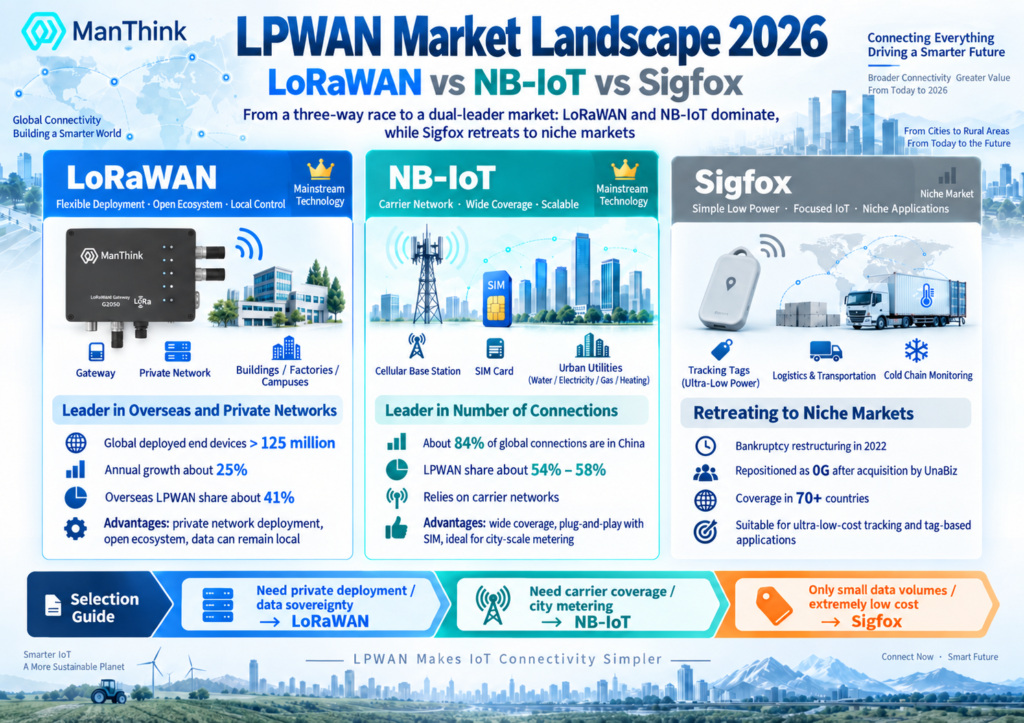
From “three-way race” to “one retreat, one hold, one advance” — Sigfox has restructured after bankruptcy, NB-IoT leans heavily on the Chinese market, and LoRaWAN runs away with the private-network segment overseas. The 2026 LPWAN story is not about displacement; it is a marathon between three business models.
1. The Short Version
If you only have 30 seconds to understand the 2026 LPWAN landscape, remember three things:
- NB-IoT holds the largest connection count, but it is highly dependent on China — roughly 84% of global NB-IoT connections are in China. Exclude China, and the picture changes completely.
- LoRaWAN leads overseas markets and China’s private-network segment — LoRa Alliance figures show more than 125 million deployed end devices growing at about 25% per year; outside China, LoRaWAN holds roughly 41% of LPWAN connections, the largest single share.
- Sigfox has exited mainstream competition — after its 2022 receivership and acquisition by Singapore’s UnaBiz for about €25 million, it was rebranded as “Sigfox 0G Technology” and now plays a supporting role in a multi-protocol convergence strategy, no longer a standalone track.
Research firms disagree widely on total LPWAN connection counts (from roughly one billion to several billion, depending on whether Chinese metering, LTE-M, and private LoRa networks are counted), but the directional conclusion is consistent: NB-IoT and LoRa together account for about 83% of the LPWAN market — a stable duopoly — while Sigfox has retreated into a niche.
2. Technology Profiles
2.1 LoRaWAN: The Open-Ecosystem Private-Network Champion
Foundation: Semtech’s LoRa physical layer (chirp spread spectrum) plus the MAC-layer protocol maintained by the LoRa Alliance. It operates in Sub-GHz unlicensed spectrum (EU868, US915, CN470, AS923, etc.) with a star topology and a four-tier architecture: end device — gateway — network server (NS) — application server.
Key parameters:
- Data rates of 0.3–50 kbps (DR0–DR5 in EU868); payloads up to ~242 bytes depending on DR
- AES-128 end-to-end encryption with OTAA dynamic joining
- Class A/B/C device types; battery life of 8–10 years is achievable
- ADR (adaptive data rate) plus LR-FHSS long-range frequency hopping for dense deployments
Market position (LoRa Alliance 2025 End of Year Report):
- More than 125 million deployed end devices, growing at roughly 25% annually
- Around 360 alliance members, with 57 added in 2025
- LoRa-family technologies hold roughly 64% of smart-building deployments — precisely because private networks don’t depend on operators
- The LoRaWAN connectivity market is projected to grow from about US
10.7B in 2025 to about US44.8B by 2030 (~33% CAGR)
Moat: You can build the network yourself. One open-source gateway (such as the ManThink GD6, with tri-path backhaul and a full protocol stack) plus an open-source NS (ChirpStack) gets you a private network where data never leaves your campus. No cellular technology offers that.
2.2 NB-IoT: The Licensed-Spectrum Regular Army
Foundation: A cellular narrowband technology standardized in 3GPP Release 13 (2016), running in licensed spectrum with a carrier bandwidth of only 200 kHz — deployable in-band, in guard band, or standalone within LTE.
Key parameters:
- Peak downlink ~26 kbps; uplink ~15.6 kbps single-tone (higher multi-tone)
- Relies on operator base-station coverage; coverage depth roughly 20 dB better than legacy GSM (MCL 164 dB)
- Power-saving via PSM, eDRX, and PSA mechanisms
- Continued evolution in 3GPP Rel-17/18, with NTN satellite connectivity validated
Market position:
- About 84% of global NB-IoT connections are in China, driven by carrier base-station upgrades since 2017 and the policy-backed migration of water and gas metering
- NB-IoT and LTE-M together reached roughly one billion active connections by the end of 2025
- NB-IoT accounts for roughly 54%–58% of total LPWAN share (with China’s weight included)
Moat: The operator network. No gateways to deploy or maintain — insert a SIM card and coverage is the carrier’s problem. The price: subscription fees, carrier lock-in, and uncertainty around network sunsetting cycles.
2.3 Sigfox: From Unicorn to “0G Technology Brand”
Foundation: Ultra-narrowband (UNB) modulation with channels only 100 Hz wide, ~100 bps uplink, 12-byte payloads, and a message budget of 140 uplinks and 4 downlinks per day. Radical simplicity buys radical low power and rock-bottom silicon cost.
Rise and fall:
- Founded in 2010; peaked at a valuation of about US$1 billion, once mentioned alongside LoRaWAN and NB-IoT as one of the three LPWAN schools
- Filed for receivership in January 2022; acquired by Singapore’s UnaBiz in April for roughly €25 million (retaining 110 of 174 employees)
- UnaBiz’s plan was never to “revive Sigfox” but to pursue multi-protocol convergence: rebranded as “Sigfox 0G Technology,” it became one option in UnaBiz’s LPWAN abstraction layer alongside LoRaWAN, LTE-M, and Wi-SUN — exemplified by Japan’s Nicigas gas-metering project, where 90% of sensors use Sigfox and 10% use Cat-M for coverage gaps
Today: The 0G network covers 70+ countries and over a billion people, with roughly 20 million devices still in service. It retains unique value in ultra-low-cost asset tracking (single-use logistics trackers, cold-chain tags). But the narrative of Sigfox as a mainstream rival to LoRaWAN and NB-IoT is over.
3. The 2026 Market in Numbers
Counting methodologies vary across research firms; sources are cited for cross-reference:
| Dimension | Figure | Source |
| LoRaWAN deployed end devices | 125M+, ~25% annual growth | LoRa Alliance 2025 EOY Report |
| LoRa Alliance membership | ~360 (57 added in 2025) | LoRa Alliance |
| NB-IoT geographic concentration | ~84% of connections in China | IEEE ComSoc Technology Blog (2026.3) |
| LPWAN share outside China | LoRaWAN ~41%, #1 | IEEE ComSoc Technology Blog (2026.3) |
| Long-range IoT connectivity revenue (2025) | NB-IoT ~6.2B (43.5%), LoRaWAN ~4.5B (31.8%), LTE-M ~2.1B (14.9%), Sigfox & others ~1.4B (9.9%) | PW Consulting market report |
| LoRaWAN connectivity market forecast | ~10.7B (2025) → ~44.8B (2030), 33.1% CAGR | Industry forecast (cited by IEEE ComSoc) |
| Duopoly concentration | NB-IoT + LoRa ≈ 83% of LPWAN | IoT Analytics (baseline, structure persists) |
| Sigfox/0G network | 70+ countries, ~20M devices in service | Sigfox/UnaBiz official |
Three cautions when reading these numbers:
- “LoRa” and “LoRaWAN” are not the same count. Cumulative LoRa chipset shipments (700M+) far exceed LoRaWAN protocol connections (125M) — many proprietary-protocol devices also use the LoRa PHY.
- China’s weight inverts conclusions. Include China and NB-IoT is the runaway leader; exclude it and LoRaWAN leads overseas. Global product planning must split the markets.
- Revenue share ≠ connection share. NB-IoT’s revenue share (~43%) is lower than its connection share (~54%–58%) because many Chinese metering connections carry very low ARPU.
4. Three Dividing Lines
Dividing line 1: China vs. the rest — two parallel markets
China is NB-IoT’s home turf: carrier-led base-station coverage and policy-driven metering migration (smart water/gas meter penetration above 80% in tier-1 cities) make NB-IoT the default in public utilities.
Overseas markets (Europe, North America, Southeast Asia, Latin America) never saw comparable carrier NB-IoT investment. LoRaWAN took roughly 41% of connections there on the strength of private networks and an open ecosystem, with growth led by smart buildings, smart agriculture, asset tracking, and campus deployments.
For product companies: in China, plan for NB-IoT and LoRaWAN coexisting; globally, LoRaWAN’s ecosystem advantage is more pronounced.
Dividing line 2: The Sigfox lesson — great technology is not a great business
Sigfox’s UNB technology remains unmatched on ultra-low power and ultra-low cost. Why did it fall?
- Closed ecosystem: Chip supply, base stations, and the cloud were all controlled by one company; partners could only act as distributors — a stark contrast to the LoRa Alliance’s 360-member open model
- Single business model: Selling connectivity alone, without end-to-end vertical solutions, stalled growth in an industry that demands solutions
- Capital mismatch: The heavy-asset “build the network first, find customers later” model burned out over IoT’s long adoption cycle
UnaBiz’s post-acquisition pivot answers each lesson: no more single-technology evangelism, but an LPWAN abstraction layer that mixes networks by coverage, cost, and use case. “Customers don’t care which LPWAN they use — they care about getting devices online at a sensible cost.” Every IoT professional should keep that sentence.
Dividing line 3: Convergence is the 2026 theme
The LPWAN market is moving from “picking sides” to “combining”:
- Amazon Sidewalk: a consumer-grade LoRa-based shared network already covering 95% of the US population, expanding into Canada and Mexico in 2026 — Big Tech chose the LoRa PHY as the foundation for mass consumer IoT
- Hybrid networking as the norm: 1NCE (cellular) and Netmore (LoRaWAN) announced integrated global coverage; UnaBiz’s 0G abstraction spans Sigfox/LoRaWAN/LTE-M
- Satellite NTN for coverage gaps: 3GPP Rel-17/18 takes NB-IoT to direct-to-satellite; the LoRa camp’s LR1121 chipset supports Sub-GHz + 2.4 GHz + satellite S-band
- LoRaWAN keeps evolving: LR-FHSS lifts dense-deployment capacity by an order of magnitude, and the 2025 Regional Parameters update tripled the top data rate
5. An Engineer’s Selection Guide
| Decision dimension | Choose LoRaWAN | Choose NB-IoT | Choose Sigfox/0G |
| Deployment model | Self-built private network | Operator network | Operator network (70+ countries) |
| Data sovereignty | Fully yours | Data transits carrier | Data transits carrier |
| Max payload | ~242 B | ~1600 B (theoretical) | 12 B |
| Downlink capability | Weak (Class A) / strong (Class C) | Fairly strong | Very weak (4 msgs/day) |
| Mobility / handover | Weak (designed for static nodes) | Moderate | Weak |
| Traffic cost | CAPEX + zero fees | SIM subscription | Subscription (lowest) |
| Entry threshold | One gateway is enough | Depends on carrier coverage | Depends on carrier coverage |
| Ecosystem openness | Open alliance, 360+ members | 3GPP standard, operator-led | Single-vendor technology (UnaBiz-operated) |
| Typical use cases | Buildings, campuses, agriculture, factories | City-scale metering, municipal assets | One-way tracking, cold-chain tags |
Three questions for a quick decision:
- Does data need to leave your site? No → LoRaWAN private network; Yes → next question
- Is there stable operator coverage at the deployment site? Yes, and the project is urban → evaluate NB-IoT; No (remote, basement, cross-border) → LoRaWAN or hybrid
- Uplink-only, 12 bytes per message enough, cost squeezed to the limit? Yes → evaluate Sigfox/0G; No → back to the first two questions
A pragmatic trend is dual-mode hybrid: LoRaWAN collects campus sensors at the access layer while backhaul runs over 4G/Ethernet; or core assets use NB-IoT for guaranteed coverage while high-density sensing uses LoRaWAN for cost control. ManThink’s GD6 gateway does this at the hardware level — LoRaWAN access plus Ethernet/Wi-Fi/4G tri-path backhaul, one device filling both network roles.
6. The ManThink Perspective: The Engineering Dividend of Private Networks
As a device vendor in the LoRaWAN camp, our read of the landscape is direct: LoRaWAN’s long-term value lies in connecting the installed base.
A huge share of sensors in industrial and building environments are wired (RS-485, M-Bus, 4-20mA, DI/DO). When retrofitting them for wireless, operator networks are neither economical nor controllable. A LoRaWAN private network lets integrators expand their sourcing from “LoRaWAN-interface sensors only” to “any wired sensor,” completing retrofits at low cost with a gateway plus wireless conversion modules (such as Edge-Bus architecture DTUs).
That is why GD6 exists as an open-source gateway and ThinkLink as a lightweight NS plus application platform: once the connectivity market settled into a duopoly, the real competition moved to lowering the entry barrier for private networks — a network in five minutes, template-based sensor onboarding, event-driven low-power edge logic. The market data backs this direction: the main engine of LoRaWAN’s 25% annual growth is precisely private and enterprise-built networks.
7. Conclusion
The 2026 LPWAN market has no winner-take-all outcome:
- NB-IoT wins on carrier infrastructure and Chinese metering — the “public-utility-grade” choice
- LoRaWAN wins on open ecosystem, private deployment, and overseas markets — the “enterprise-autonomy-grade” choice
- Sigfox lost its standalone track, but its UNB technology lives on as “0G” inside a multi-protocol convergence ecosystem
For engineers and decision-makers, the question was never “which technology is better” but “which route fits your data sovereignty, deployment environment, and cost structure” — and increasingly, the right answer is a combination, not a side.
References
- LoRa Alliance 2025 End of Year Report (Feb 2026) — 125M devices, 360 members
- IEEE ComSoc Technology Blog (Mar 2026) — NB-IoT share 54%–58%, China ~84% of global NB-IoT, LoRaWAN ~41% outside China
- PW Consulting, Worldwide Long Range IoT Connectivity Market 2026 — revenue share by technology
- Light Reading, “Sigfox rescued from receivership by Singapore’s UnaBiz” (Apr 2022) — receivership and acquisition details
- Stacey on IoT, “UnaBiz has a nice plan for Sigfox” — 0G convergence strategy and the Nicigas case
- Sigfox/UnaBiz official site — 0G network coverage data
- IoT Analytics — 83% duopoly baseline (historical)
- ThinkLink knowledge base — ManThink market positioning and product line