
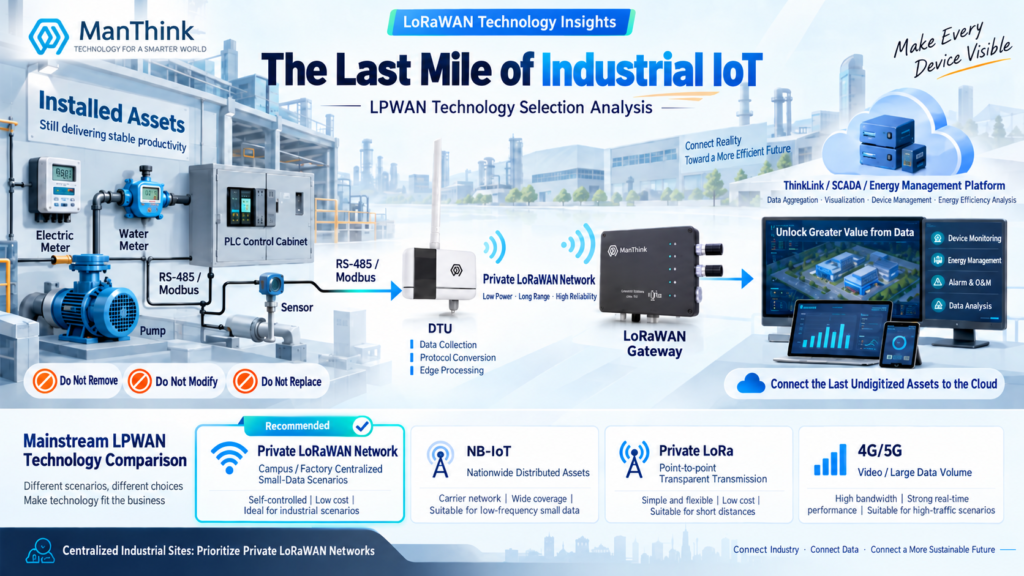
Opening: A Number Mismatch Everyone Misses
One statistic from the 2026 industrial communication market circulates widely: HMS Networks’ twelfth consecutive annual analysis shows Industrial Ethernet accounting for 79% of newly installed nodes worldwide, fieldbus dropping to 14%, and wireless holding steady at 7%.
Many conclude from this that the industrial communication war is over and Ethernet has won.
But the same research bodies (LNS Research, ARC Advisory, and McKinsey’s 2025 manufacturing benchmarks) offer another number: roughly 70% of installed industrial control assets have been in service for more than 15 years, and a meaningful share still speaks Modbus RTU over RS-485 — using a 1998-vintage protocol to report data to a controller whose vendor stopped patching firmware decades ago.
Put the two numbers side by side and the structural mismatch of industrial IoT becomes visible:
- At the **new-node** level, Ethernet has indeed won (79%);
- At the **installed-base** level, serial and fieldbus remain dominant (70% of assets older than 15 years, PLC lifespans of 10–20 years, process-industry pumps, transmitters, and valves lasting 20–30 years, and the average age of US manufacturing equipment approaching 20 years).
That is the true nature of the “last mile” problem: **it is not “the last stretch of distance” — it is “the last batch of un-digitized assets.”** These assets share three properties:
- **Cannot be removed** — the injection molder on the line, the compressor in a pharmaceutical cold chain, the pump station at the water plant: removal means downtime, and one unplanned hour on an automotive subassembly line costs five figures in scrap alone;
- **Cannot be modified** — a 1998 PLC may carry qualification documents that took a customer audit six months to obtain. Re-flashing it is not on the table;
- **Should not be replaced** — the equipment itself runs fine. Replacement means paying for an entire machine to serve the accessory need of “getting data online.”
So the technology selection question for the industrial IoT last mile was never “which wireless technology is more advanced,” but “**which retrofit route can bring installed assets online under those three constraints**.”
This article unpacks the problem: first the true shape of the installed base, then a horizontal comparison of candidate technologies, then a quantified look at four classes of industrial-environment challenges, and finally a selection decision tree you can follow.
1. Know Your Opponent: Why the Installed Base Cannot Be Eliminated
1.1 Modbus: Modest Share, Irreplaceable Position
The 2026 protocol market-share data is misleading. Modbus TCP holds **5%** of new industrial Ethernet nodes, and Modbus RTU holds **3%** of new fieldbus nodes — apparently “a declining legacy protocol.”
But note two facts.
**First, those shares have been “stable” for years.** Across HMS’s historical reports, Modbus RTU’s 3% is the flattest curve in the fieldbus category. It plays the role of the “universal connection layer”: unlike PROFINET or EtherNet/IP, which mainly serve specific vendor ecosystems, Modbus appears in equipment from virtually every major automation brand. One fact confirms its standing in cost-sensitive segments: in small-PLC and sensor access scenarios, Modbus’s share has long hovered around 80%, and a Modbus driver costs roughly one-fifth of an OPC UA driver per device.
**Second, the installed base matters far more than new-install share.** Equipment lifecycles dictate protocol survival: PLCs 10–20 years, process equipment 20–30 years. Today’s 79% Ethernet share of new nodes will not become the “installed majority” until 2036–2046; meanwhile, the tens of millions of Modbus devices still running today will keep serving for another decade or more.
This creates a powerful lock-in effect: new equipment must be compatible with existing Modbus networks, and the existence of those networks makes Modbus the natural choice for new projects. **Manufacturers do not replace stable, running systems because a protocol is “outdated” — an upgrade means coordinating a line-wide replacement or maintaining parallel communication infrastructure, both expensive and risky.**
1.2 RS-485: The Evergreen Physical Layer
Beneath Modbus RTU sits RS-485, whose longevity comes from three engineering properties:
| Property | Value / Behavior | Engineering Meaning |
|---|---|---|
| Distance without repeater | 1,200 m | Far beyond RS-232 (15 m); covers plant-level spans |
| Differential signaling | Common-mode noise rejection | First choice for high-EMI plant floors |
| Bus topology | One master, many slaves | Lowest cabling cost of any industrial bus |
| Typical slave count | Dozens on one bus | One twisted pair serves a whole metering cabinet |
Electricity meters, water meters, heat meters, flow meters, PLCs, variable-frequency drives, environmental monitors, industrial controllers — nearly every industrial metering and control device offers RS-485 terminals. That is not technological inertia; it is three decades of proven reliability.
1.3 The Communication Dilemma of the Installed Base
The problem is “access.” A typical wired architecture looks like this:
RS-485 device → Data collector → Industrial switch → Server → Management platformThis architecture works fine for “in-building, newly built, centralized” scenarios, but costs spiral out of control in four situations:
- **Across floors / buildings / campuses**: communication cable + trays + conduit + labor — communication infrastructure becomes a major cost line;
- **Operational sites**: pulling new cable through a running factory means downtime windows and hot-work permits;
- **Expansion**: every new monitoring point adds cable, and maintenance complexity compounds as the network grows;
- **Remote accessibility**: RS-485 is a local protocol by birth; going cloud requires stacking an entire additional system.
**That is the precise shape of the last-mile problem: on the device side, an RS-485 bus that runs reliably for 1,200 meters; on the platform side, a modern cloud and historian; and in between, the stretch of road that “carries serial data to the cloud” — the real bottleneck.**
2. Candidate Technology Review: The Real Boundaries of Six Routes
The candidates that actually get serious evaluation for that middle stretch are six: private LoRaWAN, NB-IoT, private LoRa (data radios), 4G/5G DTUs, Wi-Fi/BLE, and Wi-SUN. The first four are mainstream; the last two have clear boundaries in industrial settings.
2.1 Six-Dimension Comparison Table
| Dimension | Private LoRaWAN | NB-IoT | Private LoRa Radio | 4G/5G DTU | Wi-Fi/BLE | Wi-SUN |
|---|---|---|---|---|---|---|
| **Spectrum** | Unlicensed Sub-GHz | Licensed (operator) | Unlicensed Sub-GHz | Licensed (operator) | 2.4/5 GHz unlicensed | Unlicensed Sub-GHz |
| **Network ownership** | **Self-owned** | Operator | **Self-owned** | Operator | Self-owned | Self-owned |
| **Coverage** | 5–15 km (site-dependent) | Depends on operator lighting | Point-to-multipoint 3–10 km | Depends on cellular | 30–100 m | Several km, Mesh |
| **Power adaptability** | 10-yr battery or DC | Battery months–years | Requires stable DC (9–30V) | Requires stable DC | High power draw | Low power |
| **Per-message size** | Tens of bytes | Hundreds of bytes–KB | Tens of bytes | MB-scale | MB-scale | Hundreds of bytes |
| **Cost structure** | CAPEX (one-time gateways) | OPEX (SIM fee × devices × years) | CAPEX (module-level) | OPEX (data plan) | CAPEX | CAPEX |
| **Protocol adaptation** | Standard + DTU pass-through | CoAP/MQTT | Serial pass-through (any protocol) | TCP/UDP pass-through | Full IP stack | 6LoWPAN |
| **Interference immunity** | CSS spread spectrum, strong | Protected licensed band | Implementation-dependent | Licensed band | Congested 2.4G | Strong |
| **Typical role** | Campus/plant sensor network | Nationally scattered assets | Point-to-point link replacement | Bulk data / video | High-bandwidth short range | Metering Mesh (North America) |
2.2 Route by Route
**Private LoRaWAN** — the advantages are threefold “ownership”: unlicensed spectrum, self-built network, sovereign data. The gateway sits on your own site; coverage is defined by you. It does not depend on whether an operator has lit up NB-IoT on a given mast, and there is no risk of devices going dark en masse because an operator sunsets a service (a real failure category in NB-IoT deployments). The price: up-front CAPEX and gateway operations responsibility that stays with you. CSS modulation gives it natural resistance to narrowband interference, and the Sub-GHz band diffracts around concrete and metal far better than 2.4 GHz.
**NB-IoT** — the advantage is “no network to build”: you use operator infrastructure directly, which suits assets scattered nationwide (shared-bike locks, manhole covers, cross-border logistics). The price: a per-SIM annual fee (OPEX that grows linearly with fleet size), coverage entirely dependent on the operator (indoor, basement, and remote plant areas are often unlit), and service-continuity risk over the device lifecycle. **In industrial scenarios where devices cluster on your own site, NB-IoT’s advantages are mostly unusable while its disadvantages are fully exposed.**
**Private LoRa radios (data radios)** — the difference from LoRaWAN is the absence of a standard protocol stack: point-to-multipoint transparent pass-through with custom protocols. It suits “stable power, no cellular coverage, private protocol” scenarios, such as water-quality monitoring at a mountain fish farm (24V power available, no cellular signal, Modbus data across 3 km). The price: none of LoRaWAN’s standard ecosystem (NS, platforms, certified device pool), with management costs rising at scale.
**4G/5G DTUs** — the bandwidth route. Tower-crane video monitoring and AGV bulk telemetry can only go here. Using it for metering-grade small messages is economically irrational: you pay for megabytes and transmit tens of bytes.
**Wi-Fi/BLE** — high-bandwidth short range, suited to AGVs/AMRs and handheld terminals. In industrial sensing the problems are poor 2.4 GHz penetration, high power draw, and the cost of dense AP deployment. A pharmaceutical cold-storage lesson: the insulation is thick metal plate plus polyurethane foam; a Wi-Fi solution attenuated badly inside the chamber and dropped constantly; the final fix was 470 MHz LoRaWAN, where **one gateway penetrated 20 cm of cold-storage insulation and covered the entire campus**.
**Wi-SUN** — Sub-GHz Mesh with an installed-base advantage in North American metering, but its ecosystem and device selection are far smaller than LoRaWAN’s in industrial scenarios elsewhere; it usually enters evaluation only when a customer explicitly specifies it.
2.3 A Quick-Reference Conclusion Table
| Your Scenario | First Choice | Rationale |
|---|---|---|
| Devices clustered on your own site; metering/status small messages | **Private LoRaWAN** | Sovereign coverage, no SIM fees, CSS interference immunity |
| Assets scattered nationwide, no fixed site | NB-IoT | Trade self-built cost for operator coverage |
| Point-to-point 3–10 km, stable power, private protocol | Private LoRa radio | Flexible pass-through, no platform dependency |
| Video / large files / high-frequency waveforms | 4G/5G | The only bandwidth answer |
| Already a nationwide metering Mesh (North American legacy) | Wi-SUN | Legacy continuity |
3. Four Classes of Industrial-Environment Challenges: Separating “Works” from “Works for Ten Years”
A selection table only answers “which route.” The cruelty of industrial sites is that **the numbers on a datasheet and the site three years later are different things.** Four challenge classes decide equipment-selection survival.
3.1 Metal and Electromagnetics: Where 15% Packet Loss Comes From
The three least wireless-friendly things on an industrial site: metal structures (reflection, blockage), VFDs and motors (EMI), and dense radio equipment (co-channel interference).
A mining case provides representative measured data: in large-scale mining and petrochemical facilities, **commercial off-the-shelf gateways in plastic enclosures showed a 15% packet-loss rate**, causing frequent manual resets and on-site technician visits; after switching to a solution with optimized RF shielding and industrial-grade components, packet loss fell to **0.8%**, annual downtime dropped from 48 hours to 4, and per-unit annual maintenance cost fell from $1,200 to $150.
LoRaWAN’s confidence in such environments comes from the technical layer:
- **CSS (Chirp Spread Spectrum) modulation** spreads signal energy across the whole bandwidth, giving natural immunity to narrowband interference (VFD harmonics, motor arcing) — precisely why it remains viable in “electrically dense” environments;
- **The Sub-GHz band** (470 MHz in China, 868 MHz in Europe) diffracts and penetrates significantly better than 2.4 GHz;
- **ADR** lets weak spots automatically retreat to higher SF for link margin, at the cost of longer airtime;
- **FEC** lets receivers repair damaged packets.
But three disciplines still apply: keep antennas off metal longitudinal axes, stay more than 30 cm from reflective surfaces, and do frequency planning across multiple gateways. In high-EMI environments, consider actively pushing SF down to 7/8 — sacrifice extreme range for shorter time-on-air and lower interference exposure.
3.2 Temperature: What Freezes and Cracks at -80°C Is Not the Sensor
The conventional industrial temperature requirement is **-40°C to +85°C**, and that number alone is not hard to meet (standard industrial-grade component binning). The traps are in the details:
A 2,000 m² pharmaceutical cold-storage project (three -80°C ultra-low freezers plus one 2–8°C cold room, holding over ¥50M of vaccines and blood products) learned this the hard way: on day one of the LoRaWAN deployment, data from the -80°C chamber was still unstable. Investigation showed **the problem was not radio but the rubber jacket of the probe wiring, which hardened and embrittled at ultra-low temperature, causing intermittent contact**. The fix: replace with Teflon-jacketed low-temperature shielded cable and pot every terminal with sealant.
The general lesson: cold’s failure points are usually in “accessories” — cable, connectors, battery — not the chips on the main board. At selection time, audit wiring, terminals, and packaging with the same rigor as the host. Placement matters too: probe into the chamber, host outside — protecting both measurement accuracy and battery performance in the cold.
3.3 Power Supply: AC Wide-Voltage Is an Underrated Differentiator
Industrial-site power is far dirtier than assumed: voltage fluctuation on shared supplies, harmonics fed back by VFDs, maintenance outages. “Unexpected gateway/DTU reboot interrupting packet forwarding” is a high-frequency failure class, and diagnosing it is extremely expensive at unattended sites.
Here an important selection fork appears — **the DTU’s power format is effectively doing scenario segmentation for you**:
| Power Format | Fitted Scenario | Typical Product Form |
|---|---|---|
| **AC 85–270V wide voltage** | Inside power/metering cabinets, drawing site AC directly | Rail-mounted DTU |
| **DC 5–24V** | Low-voltage cabinets, instrument boxes | Compact rail DTU |
| **Battery (Li-SOCl₂, 10,800 mAh)** | Remote points with no supply | Battery DTU |
AC wide voltage (85–270V) means the device can hang inside a power distribution cabinet in any country without a separate adapter — in retrofits, that is the difference between “installable” and “not installable.” For battery versions, audit sleep current (industry level ≤5–15 μA) and battery internal-resistance degradation in the cold.
3.4 Operations Inaccessibility: Remote Manageability Is the Industrial-Grade Threshold
Large numbers of industrial points are “install and never visit.” Robustel’s summary of industrial gateway failure modes is apt: **many gateway failures are not caused by the “outdoors” but occur indoors in apparently protected locations — high temperature in metal cabinets, condensation during start/stop cycles, shared-supply fluctuation, motor interference, signal attenuation through the metal cabinet, restricted maintenance access.**
That turns remote management from a nice-to-have into a survival requirement. At minimum: remote parameter configuration (via the NS, no site visit), remote firmware upgrade (FUOTA), disconnect-reconnect with data buffering and retransmission (for metering continuity), and remote health visibility (battery level, signal quality, module self-check).
4. The Selection Decision Tree: Five Questions to Fix the Route
Converging the preceding analysis into five questions, answered in order:
Q1. What is the data profile?
    ├─ Video / large files / high-frequency waveforms ───→ 4G/5G DTU. End of analysis.
    └─ Metering / status / alarms (small messages) ───→ Q2

Q2. Are devices clustered or scattered?
    ├─ Scattered nationwide, no fixed site ───────────→ NB-IoT (use operator coverage)
    └─ Clustered on your own site / campus ───────────→ Q3

Q3. Is there deep cellular coverage on site (indoor/basement/metal plant)?
    ├─ Yes, and customer accepts OPEX ───────────────→ NB-IoT viable; recheck at Q4
    └─ No, or network sovereignty required ──────────→ Private LoRaWAN; proceed to Q4

Q4. What interface do the target devices have?
    ├─ RS-485/Modbus, M-Bus, 4-20mA, DI/DO (installed wired assets)
    │    └─→ DTU route: keep original devices, replace only the last hop → Q5
    └─ New sensor points
         └─→ Choose native LoRaWAN sensors directly → Q5

Q5. What is the power condition at the points?
    ├─ Power/metering cabinet (AC available) ────────→ Rail DTU (AC wide voltage)
    ├─ Low-voltage cabinet (DC 5–24V) ──────────────→ Compact rail DTU
    └─ No supply ───────────────────────────────────→ Battery DTU (audit sleep current
                                                        and cold performance)
The tree’s three pivotal judgments:
- **Q2 is the watershed**: the distribution shape of devices (clustered vs. scattered) determines the route earlier than any technical parameter. Most industrial scenarios fall on the “clustered” side — which explains why industrial private networks are LoRaWAN’s fastest-growing segment.
- **Q4 is where the money is**: if the target devices are RS-485 installed assets, the DTU route expands your sensor sourcing from “LoRaWAN-interface sensors only” to “any wired sensor” — far cheaper, far more options, and **not one line of code changes on the original equipment**.
- **Q5 is the final gate to deployment**: power format determines the specific model and the installation workload (whether you must provision a separate power supply for the DTU).
5. ManThink’s Answer: The DTU Route and EdgeBus
With the methodology covered, here is our own engineering answer. Since its founding in 2014, ManThink has focused on a single positioning: **connecting the installed base** — low-cost wireless retrofit of wired-interface field devices (RS-485, M-Bus, 4-20mA, 0-10V, DI). The output of that route is a complete DTU product line plus an edge-computing virtual machine that runs inside the DTUs.
5.1 Three DTUs Segmented by Power Condition
| Parameter | KC11 | KC25 | KC21 |
|---|---|---|---|
| Positioning | Rail-mounted industrial workhorse | 2nd-gen compact rail | Battery-type remote points |
| Power | **AC 85–270V wide voltage** | DC 5–24V | 4× ER14505 Li-SOCl₂ (10,800 mAh) |
| Interface | RS-485 | RS-485 | RS-485 |
| Mounting | DIN rail | DIN rail | Wall-mount (PG7 gland) |
| Operating class | Class C | Class C | Class A (battery) / Class C (DC) |
| TX power | 22 dBm | 22 dBm | 22 dBm |
| RX sensitivity | -142 dBm @SF12 | -142 dBm @SF12 | -142 dBm @SF12 |
| Temperature | -40 to +85°C | -40 to +85°C | -40 to +85°C |
| Protection | IP53 (in-cabinet) | Aluminum enclosure | **IP65** (outdoor) |
| Distinguishing feature | Compatible with all RS-485 protocols | Ultra-compact (69×25×25 mm) | **Can power external sensors** |
| Deployment scale | **100,000+ units deployed** | Current generation | Harsh points |
The three models cover all three branches of decision-tree Q5: AC from the power cabinet with KC11, DC from the low-voltage cabinet with KC25, and no-supply remote points with the battery KC21 (IP65 outdoor protection, plus the ability to power external water/gas meters — saving a whole supply system).
All support the six regional standards — CN470/EU433/EU868/AS923/AU915/US902 — and connect to any standard LoRaWAN platform: ThinkLink, ChirpStack, or TTN. **No lock-in at the gateway or platform layer** — the fundamental difference from vendors of “complete closed systems.”
5.2 EdgeBus: Why Protocol Adaptation Cannot Be Just “Configuration”
The deepest pit on the DTU route is not radio but **protocol adaptation**. On the surface, connecting a Modbus meter means configuring a slave address, register map, and data types. In real projects:
- Electricity meters speak **DL/T 645-2007**, water/gas/heat meters speak **CJ/T 188**, imported instruments speak all manner of proprietary protocols — three address lengths (1/6/7 bytes), three frame formats, each with its own CRC;
- You need **COV (Change of Value)**: don’t transmit when metering data hasn’t changed — saving not just airtime but battery life;
- You need **threshold logic**: report a temperature violation immediately, not at the next cycle;
- You need **data restructuring**: split, scale, and structurally package multiple register values from one 485 frame.
ManThink’s answer is **EdgeBus (EB)**: an event-driven edge-computing virtual machine. You write collection logic in TypeScript, compile it to a few hundred bytes of binary, and run it low-power on a Cortex-M0-class MCU. Its runtime model is two periodic events:
- **Query event**: periodically send commands to RS-485 sub-devices and fetch raw data;
- **Uplink event**: periodically package processed data and send it via LoRaWAN.
EB natively supports Modbus (CRC checks, integer/float/BCD read-write), DL/T 645, CJ/T 188, and any custom protocol, and completes COV, alarm triggering, and data restructuring locally at the endpoint — **with that logic pushed down to the device, uplink data volume, airtime consumption, and cloud-side parsing burden all fall together**.
More important is the change in engineering workflow: EB code is debugged and upgraded entirely online. In real projects you can **install the hardware on site first, then push the business logic via FUOTA** (multi-bin block-wise, compressed low-power over-the-air upgrade) — decoupling field installation from software debugging. For retrofitting factories that cannot be stopped, this is decisive: hardware installation fits in one maintenance window; protocol adaptation is done slowly from the office.
5.3 A Chain Proven Across 100,000 Units
Assembling the full chain:
Installed RS-485 devices (meters / PLCs / transmitters, untouched)
    ↓ RS-485 / Modbus / DL/T645 / CJ/T188
DTU (KC11/KC25/KC21, EB VM runs protocol parsing & COV locally)
    ↓ LoRaWAN (CN470 private network, CSS interference immunity)
Gateway (GDI51/GDO51/GD61x, per indoor/outdoor and scale)
    ↓ Ethernet / Wi-Fi / 4G backhaul
NS + Platform (ThinkLink, or ChirpStack/TTN — no lock-in)
    ↓
SCADA / BMS / energy management / third-party platforms
The economics of this chain: **installed wired assets see zero replacement; only the “last hop” wireless conversion layer is added.** Compared with the “replace with native LoRaWAN sensors” route, per-point cost drops sharply; compared with the “replace whole machines” route, the cost differs by an order of magnitude. The KC11 alone passing 100,000 deployed units is the most direct evidence that this route has survived real industrial sites.
6. Five Common Misconceptions
**Misconception 1: “79% of new nodes are Ethernet; serial is being phased out.”** New-install share and installed base are two different statistical frames. With 70% of in-service assets older than 15 years and process equipment lifespans of 20–30 years, serial devices will keep serving on-site for another decade — “phase-out” is a 2040s topic. The last-mile problem exists precisely inside that time gap.
**Misconception 2: “Operator networks are broad; just use NB-IoT on industrial sites.”** “Broad coverage” means outdoor ground level. The places industrial assets live — inside power cabinets, basements, deep inside metal plants, remote sites — are exactly where deep cellular coverage is worst. The more practical problem: NB-IoT’s OPEX model (SIM annual fee × device count × years) is a continuously growing bill at thousand-point scale, and service continuity over the device lifecycle is not under your control.
**Misconception 3: “LoRaWAN capacity is insufficient for industrial point counts.”** We did this math in Issue #10: a single gateway carries five-figure node counts at SF7 and hundreds at SF12. Industrial metering messages are “tens of bytes every 15 minutes” — the real bottleneck is coverage, not capacity. Coverage-starved points pushed to SF12 by ADR are the capacity killers, so well-placed gateways are themselves the most effective capacity upgrade.
**Misconception 4: “A DTU is just a pass-through module; buy a cheap one.”** Pass-through only moves bytes from serial to cloud. What decides project survival is protocol parsing (the address-length differences of DL/T645/CJ188), COV strategy (the key to battery life), FUOTA (the only way to fix logic defects when no one can reach the site), and wide-voltage power (whether it installs in a distribution cabinet). These capability gaps are invisible at selection and visible in year three. The mining case’s 15% vs. 0.8% packet-loss gap and the $1,200 vs. $150 annual maintenance gap are the three-year ledger of “cheap off-the-shelf” versus “engineered product.”
**Misconception 5: “Wireless retrofit means touching the original system — too risky.”** The opposite is true: the DTU route is the least invasive of all retrofit paths — original equipment untouched (no re-flashing, only a parallel connection onto the 485 bus), original control systems running as before, wireless layer independently overlaid. The real risk lives in routes that “modify the original system” — that is where qualification documents lapse, SIL ratings need re-assessment, and downtime windows appear.
7. A Closing Clarification
The industrial IoT last mile is often framed as a technology contest: “LoRaWAN or NB-IoT?” This article’s argument: **that framing itself asks the wrong question.**
The real question is: **under the three constraints (cannot remove, cannot modify, should not replace), how do you bring in-service installed assets online?** Under those constraints:
- Data profile routes first (video to 4G/5G, metering to LPWAN);
- Device distribution picks the path (clustered → private network, scattered → operator);
- Target assets pick the form (RS-485 installed base → DTU route, new points → native sensors);
- Power condition picks the model (AC cabinet / DC cabinet / no-supply points).
And technology selection is only the entry ticket. What decides whether a project lives to year five is engineering detail beyond the datasheet: cable that does not embrittle at -40°C, a 0.8% packet-loss rate next to a VFD, a wide-voltage design that draws power directly in the distribution cabinet, and remote upgrade capability that frees protocol adaptation from on-site debugging.
The next decade of industrial digitalization will be fought not in brand-new smart factories but in legacy sites where “the equipment has more seniority than the engineers.” Whoever completes the last mile with the lowest invasiveness holds the ticket to this market.
Appendix A: Glossary
| Term | Definition |
|---|---|
| LPWAN | Low-Power Wide-Area Network; umbrella term for LoRaWAN/NB-IoT/Sigfox/Wi-SUN |
| DTU | Data Transfer Unit; protocol-conversion terminal between serial devices and wireless networks |
| Modbus RTU | Master-slave serial industrial protocol running on the RS-485 physical layer |
| DL/T 645 | Chinese power-industry standard protocol for multi-function electricity meters |
| CJ/T 188 | Chinese urban-construction standard protocol for household metering instruments (water/gas/heat) |
| COV | Change of Value; do not upload unchanged data |
| FUOTA | Firmware Update Over The Air for LoRaWAN |
| CSS | Chirp Spread Spectrum; the LoRa physical layer, resistant to narrowband interference |
| ADR | Adaptive Data Rate |
| EB (EdgeBus) | ManThink’s event-driven edge-computing VM; written in TypeScript, runs low-power on MCUs |
| Installed base | The retrofit market of already-deployed, mostly wired-interface devices |
| SIL | Safety Integrity Level |
Appendix B: References
- HMS Networks, *Industrial Network Market Analysis 2026* — Ethernet 79% / fieldbus 14% / wireless 7% of new nodes; PROFINET 30%, Modbus TCP 5%, Modbus RTU 3%
- LNS Research / ARC Advisory / McKinsey 2025 manufacturing benchmarks — ~70% of installed industrial control assets older than 15 years
- QYResearch, *Global Industrial DTU Market Research Report 2026* — $709M (2025), $750M (2026), $1,052M (2032), CAGR 5.8%, average price $102, ~6.95M units/year
- 360iResearch / Data Insights Market, *Industrial Wireless DTU Market* — $1.37B (2025), CAGR 8.85%
- NiceRF, “LoRa, LoRaWAN, NB-IoT, and 4G DTU: Industrial Wireless Solution Selection Analysis” — four-technology comparison and three selection cases
- KaaIoT, *NB-IoT vs LoRaWAN: which to use for industrial IoT applications?* — CAPEX/OPEX structures, coverage behavior, interference immunity
- VolleyBoast, *Using VoBo in Noisy Industrial Environments* — CSS interference immunity and deployment discipline in industrial EMI
- Robustel, *How to Choose an Industrial LoRaWAN Gateway for Harsh Environments* — failure-mode analysis of “hidden harsh” indoor environments
- AnyPCBA industrial gateway case — 15% → 0.8% packet loss in high-interference mining sites; 68% TCO reduction over three years
- Yunzhibian pharmaceutical cold-storage case study — 470 MHz penetrating 20 cm insulation; -80°C cable-embrittlement lesson
- ThinkLink official documentation — KC11/KC25/KC21 DTU specifications, EdgeBus architecture, ManThink company positioning (www.think-link.net)
- ManThink, “How to Quickly Connect Traditional RS485 Devices to a LoRaWAN Network” — RS-485 installed-base integration architecture